This article was translated by an AI
Long-term, geology decides
Radioactive waste must be safely packaged in containers. This protects people and the environment. However, for long-term safety, geology is the decisive factor.
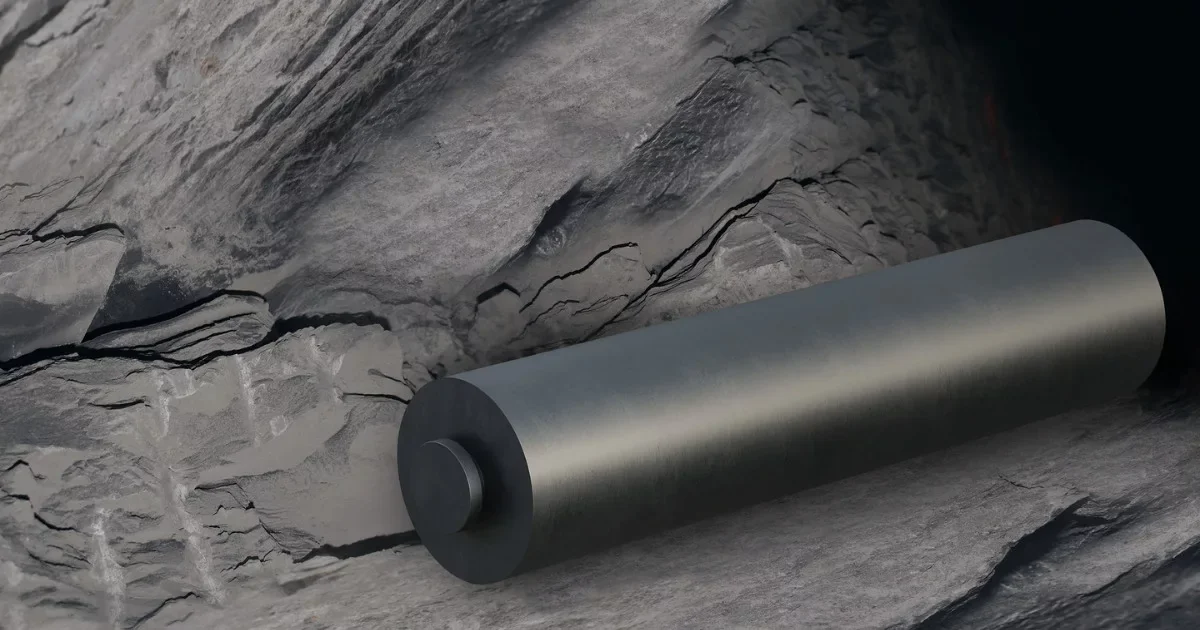
Today, Switzerland's highly radioactive waste is stored in Würenlingen in the canton of Aargau. There, it is packaged in large, massive containers until the disposal in a geological deep repository can begin. Once this stage is reached, the waste will be removed from the storage containers, repackaged into smaller disposal containers and transported to the deep repository in transport casks. From the surface facility at Stadel in the Zürich countryside, the waste then reaches the deep repository. And only there, down at a depth of almost 900 metres, will the disposal containers be removed and emplaced.
Along the entire route, from the interim storage to the drifts in the deep geological repository, all these containers play an important role. Thanks to them, the waste is so well packed that protection of people and the environment is ensured even in events such as a fire or traffic accident. In addition, the thick-walled steel containers shield part of the radiation.
A large gap exists
The safe packaging of radioactive waste is central to its storage in the interim storage facility, transportation and operations during emplacement in the deep geological repository. In this context, reference is made to so-called operational safety. When the waste is stored in the sealed drifts of the deep geological repository, reference is made to long-term safety. What role do the disposal containers play during this long period?
It is likely that the containers will be constructed of steel. A guideline stipulates that they must remain sealed for at least 1,000 years. For this duration, they must completely enclose all radioactive particles - the radionuclides. Therefore, the containers must not have rusted through by then.
Yet are these 1,000 years sufficient for the long-term safety of the deep geological repository? Nagra must demonstrate that the deep geological repository protects humans and the environment from radiation for up to a million years. 1,000 years here, hundreds of thousands there: this creates a large, explainable gap.
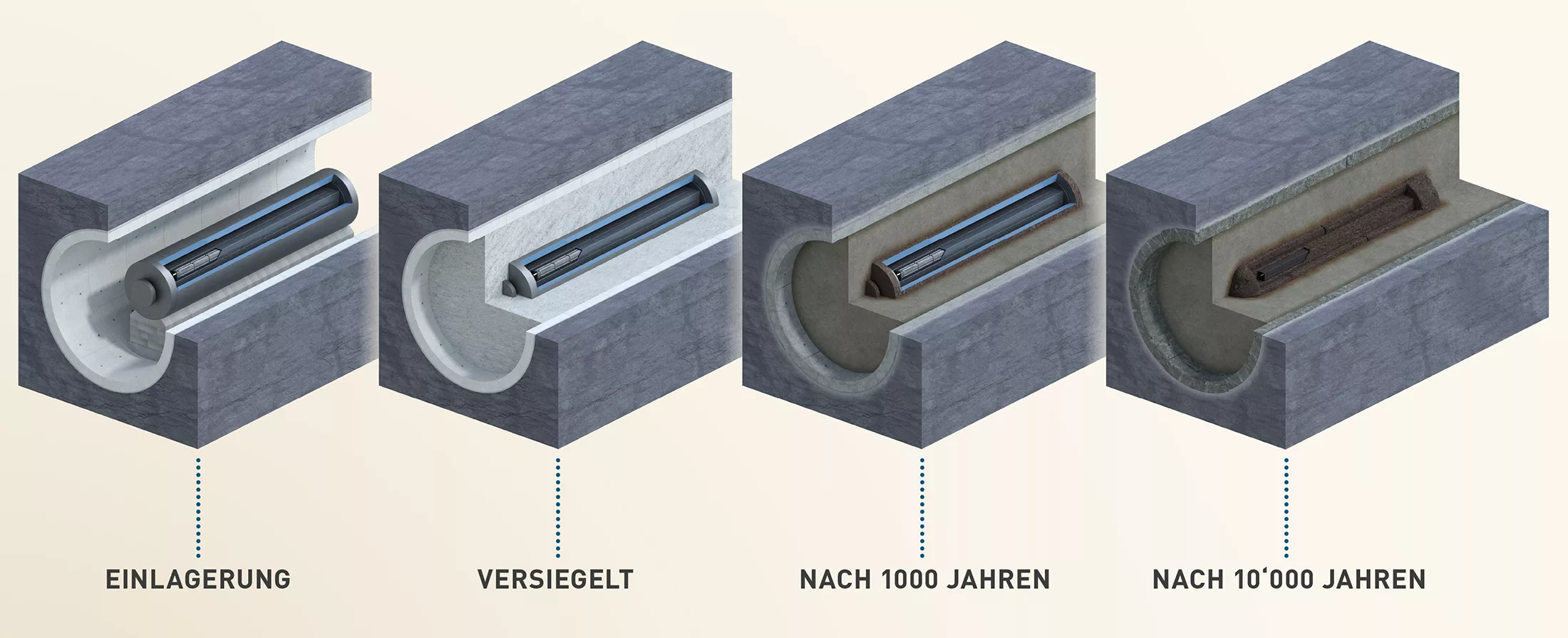
Although Nagra assumes that a steel disposal container would remain sealed for significantly longer than the required 1,000 years, this duration could be further increased by using materials such as copper, ceramics or titanium. Exactly how the container will ultimately be constructed is deliberately left open for now.
Because several decades will pass until the waste is emplaced. And during this time, further advances are to be expected, for example in materials science. If the exact appearance of the disposal containers were fixed today, such technical-scientific advances could no longer be incorporated and used in the future. However, optimisations to the disposal container are not aimed at increasing the required duration of 1,000 years towards one million years – because that would not bring any safety benefit.
Are 1000 years a lot or little?
When comparing such time periods, one must take into account the so-called half-life of radionuclides. As time progresses, the radiation problem is gradually mitigated. In contrast to eternal chemicals, radioactive substances are slowly converted into harmless materials.
The physical process behind this transformation is radioactive decay, which occurs at different speeds depending on the type of radioactive element. For example, caesium-137 has a half-life of about 30 years. This means: after 30 years, half of the radioactivity is still present, while the other half has been transformed into another element through decay.
The half-lives of other radioactive elements range from a few seconds via weeks up to tens of thousands of years. Thus, they decay at different rates.
Considering the total radiation emitted by the contents of a disposal canister, it becomes clear: The required thousand years may seem short compared to a million years. However, within this one-thousandth of the time in which the canister must fully enclose the highly radioactive waste, 90 percent of the radioactive substances will have decayed.
A barrier follows another
It therefore concerns the remaining ten percent of radiation. These are persistent because they have much longer half-lives, so-called long-lived radionuclides. As they will survive the disposal containers, additional safety barriers are needed in the deep repository. These barriers complement each other and together ensure the long-term safety of the repository.
Therefore, the entire system is referred to as a multiple-barrier concept. The disposal container is one of these barriers, which opposes the spread of radioactive particles. And even within the container, there is another barrier: The radionuclides are not liquid, but bound and enclosed in a solid form. Thus, in the spent fuel assemblies, the radioactive material is fixed in cylindrical pellets and surrounded by metal tubes. Likewise, the low- and medium-level radioactive wastes are fixed in a solid mass such as glass or cement, packed into thick-walled concrete containers and stored.
Whether after 1,000 years, 10,000 years or even later: At some point the disposal container will no longer be tight. That it will eventually rust through is a basic assumption in the planning of the deep geological repository. If radionuclides then escape from the no longer tight container, they will encounter the next barrier: the backfill material. This material is used to fill and seal the void between the containers and the tunnel wall. It will consist of bentonite or another clay-containing material that retains further radionuclides. Finally, the accesses to the deep geological repository will also be filled and sealed – another barrier.
A Hurdle Race Against Half-Lives
Certain radioactive particles will overcome the backfilled voids, hit the walls of the emplacement drifts and thus encounter the crucial safety barrier: Opalinus Clay. The claystone, in which the deep repository is constructed, is by far the most important barrier against the spread of radioactive substances. Above and below the emplacement drifts, this rock layer is approximately 50 metres thick. Adjacent to it, there are further clay-bearing layers that make an additional contribution to the containment of radioactive particles.
As the heart of the deep geological repository, Nagra and other research organisations have been investigating Opalinus Clay for decades. The central question is: How do the various types of radionuclides move within this clay rock?
Its outstanding significance in the multiple-barrier concept is due to three properties of Opalinus Clay. Firstly, it is practically impermeable to water and gas. Secondly, it seals cracks in the rock that may have formed again. Thirdly, certain radionuclides remain virtually attached to it, further slowing their spread. To also take into account the worst possible case, Nagra has based its calculations on Worst-Case scenarios.
All these barriers can be imagined as hurdles set up one after the other. The radionuclides with their different half-lives are like runners in a race against time. They move, albeit very slowly, through the various materials. This happens through a process called diffusion, during which a substance spreads from an area of high concentration to one of low concentration.
Allerdings kommen die «Läufer» unterschiedlich weit, weil sie unterschiedlich fit sind. So bleiben viele schon im Endlagerbehälter hängen, wo sie zur Unschädlichkeit zerfallen. Andere schaffen es zwar weiter, stolpern dann aber über eine der nächsten Hürden. Kurz: Die gestaffelten Barrieren verzögern die Ausbreitung der Radionuklide im Lauf ihrer Halbwertszeiten.
The Nagra has intensively studied the various properties of radionuclides – the «runners». For example, heavy particles move more slowly because they have to squeeze through the narrow pores of the Opalinus Clay. Other radionuclides are attracted to the clay rock and stick to it like a magnet.
So each "runner" has its own speed. How far will it get before it disintegrates? And what would happen if the rock were to break, thereby creating possible shortcuts for radionuclides? These questions are important in order to estimate the maximum radiation dose that could potentially reach the environment from the deep geological repository.
Nature exceeds technology
The protection during transport, storage and total encapsulation for at least 1000 years: Disposal containers for highly radioactive waste are important - also for the required retrievability of the waste. However, they are not decisive for the long-term safety of the geological deep repository.
So show Nagra's dose calculations that it would make no difference if these containers were missing. The thick and dense Opalinus Clay rock layer seals the radioactive waste so effectively that hardly any radioactive substances reach the environment and the limit values are exceeded by orders of magnitude – even without disposal containers. The naturally occurring geology is thus far superior to all technical safety barriers.
You may also be interested in
We believe in transparency. Here you can find the latest updates and information about this landmark project.
Yellow Barrels and Glowing Rods? What Our Radioactive Waste Really Looks Like
There are various types of radioactive waste. However, popular culture almost always misleads us about their properties…
.jpg)