Where will Terradura be constructed?
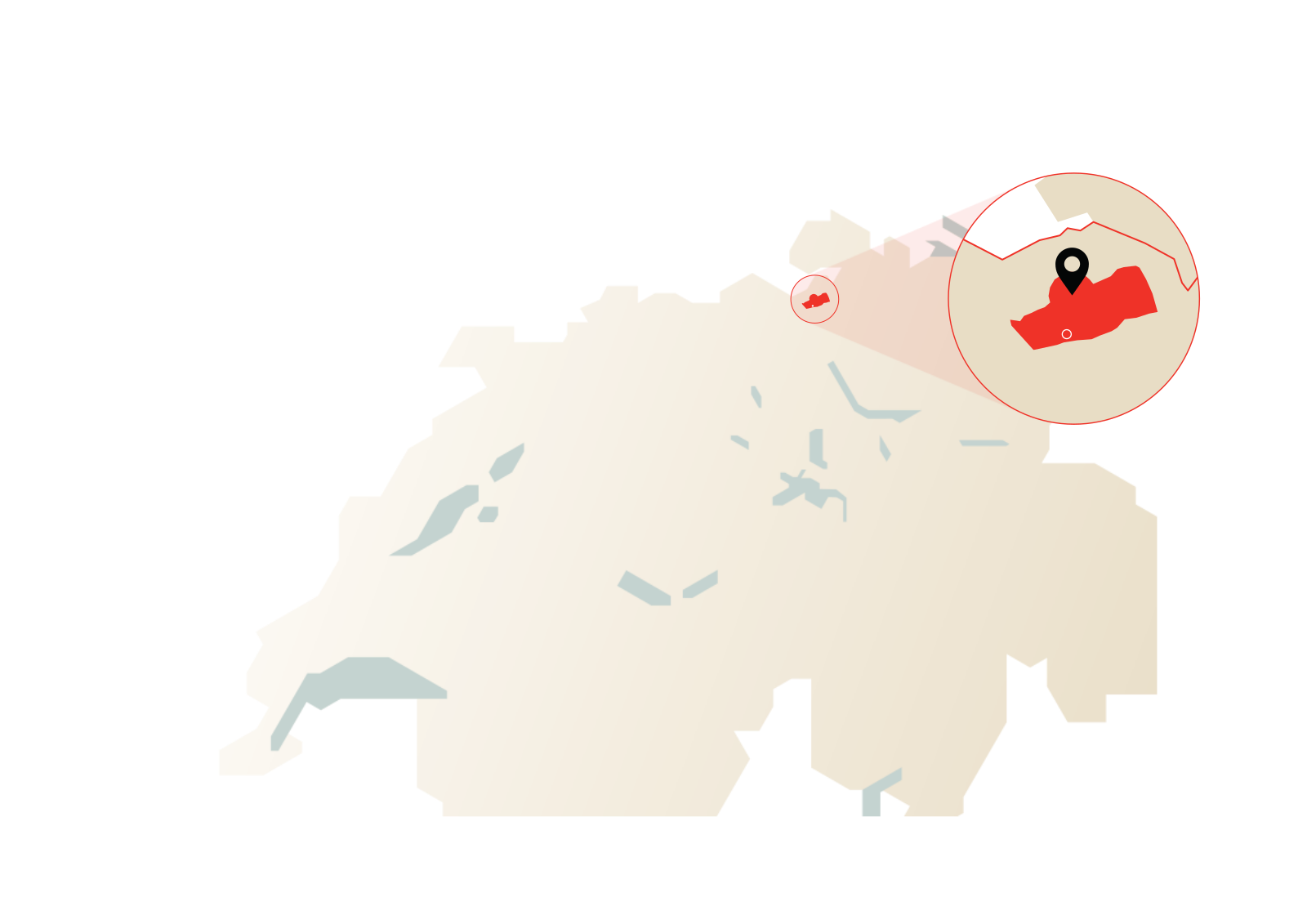
The repository will be constructed in the Zürcher Unterland (the northern part of Canton Zürich). During the search for the most suitable repository site in Switzerland, this siting region was named “Nördlich Lägern”. We can now be more specific: the facilities that will be visible at the surface are to be constructed in the Haberstal area in the community of Stadel.
Three reasons for choosing Nördlich Lägern
Search for the most suitable site
The search for the safest repository siteis being carried out in line with the “Sectoral Plan for Deep GeologicalRepositories”.
The Federal Government has the lead inthis wide-ranging procedure. The decisive factor for the safety of a repositorysite is the stability of the underground conditions rather than of those at thesurface. Political aspects play a subordinate role in determining the mostsuitable site; geology and operational safety are the crucial factors.Socio-economic and spatial-planning aspects also play a role, but they aresecondary to safety.
Affected parties can participate in thesite selection process. The responsible Swiss Federal Office of Energy (SFOE)provides more information on regional participation.
Why here of all places?
Northern Switzerland is the most suitable geological corridor for a deep geological repository. This is where the Opalinus Clay is of ideal depth, quality and extent and is also comparatively undisturbed. In the final stage of the Sectoral Plan, Nagra investigated the three remaining potential siting regions in great depth. The result: the most suitable site with the largest safety reserves is located in the so-called Nördlich Lägern siting region in the Zürcher Unterland (the northern part of Canton Zürich).
How does a repository like Terradura work?
Indispensable: the Opalinus Clay
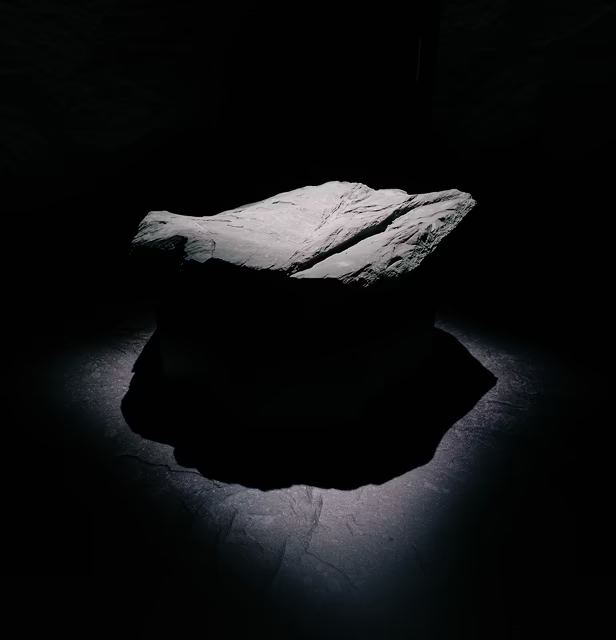
This nondescript clay rock can protect humans and the environment for a very long time period thanks to three special properties:
- it is largely impermeable to water
- it can self-seal fissures
- it binds radioactive substances
These properties make the Opalinus Clay the perfect host rock for Switzerland’s deep geological repository.
The Opalinus Clay was formed over 170 million years ago. Remarkably, it has hardly changed since then; time has practically stood still for it.
Who are we?
Nagra is driving forward a project of the century: Terradura, Switzerland’s deep geological repository. We will eventually be able to safely dispose of our radioactive waste in it – for the protection of humans and the environment. Here at Nagra, we are committed to achieving this goal by dedicating our scientific and technological expertise and seeking dialogue with the public.