This article was translated by an AI
Bunker-Busting Bombs and Deep Geological Repositories: What Happens?
The GBU-57, the US bunker-busting bomb, was deployed. Could such a bomb endanger the deep geological repository? A thought experiment.

Worldwide, there are various underground nuclear facilities. They are considered particularly secure and well protected against attacks. Now, the USA over the weekend attacked the Iranian nuclear facility at Fordo and according to their own statements destroyed it. At Fordo, Iran enriches uranium at a depth of 80 to 90 metres under the mountain . During the US attack, among other things, the bunker-busting bomb GBU-57 was used. It was specifically developed to destroy deeply buried and heavily fortified targets.
We are interested in the question: Could such bombs theoretically also endanger the Swiss deep geological repository?
How the US bomb works
The GBU-57 is dropped from several thousand meters in height. The bomb falls more or less vertically towards the ground – it finds its target via a GPS guidance system. Due to its high weight of approximately 14 tons and the high speed upon impact, it penetrates deeply into the ground – up to 60 meters depending on the terrain. A delay fuse allows the bomb to explode only deep underground.

A potential risk for the deep geological repository?
The short answer is: No. Apart from the fact that it is hard to imagine any realistic scenario in which an attack on a deep geological repository would make military sense for an attacker: the planned deep geological repository is to be constructed at a depth of about 800 metres. Hard rock layers partly lie above the rather soft Opalinus Clay, in which the repository is to be built. Even a large number of bunker-busting bombs would not be able to reach this depth. This applies at least in the case of an already sealed deep geological repository. In this state, all access to the repository is filled in.
If the shafts down to the repository were still open, conventional bombs could also destroy the access routes completely or partially. However, even in that case, there would be no danger for the vast majority of radioactive waste: It is not stored directly at the access points, but in extensively branched drifts. Moreover, the emplacement drifts are continuously backfilled as soon as they have been loaded with waste.
So could the deep geological repository look like?
Image generated by AI / Shutterstock.com
You may also be interested in
We believe in transparency. Here you can find the latest updates and information about this landmark project.
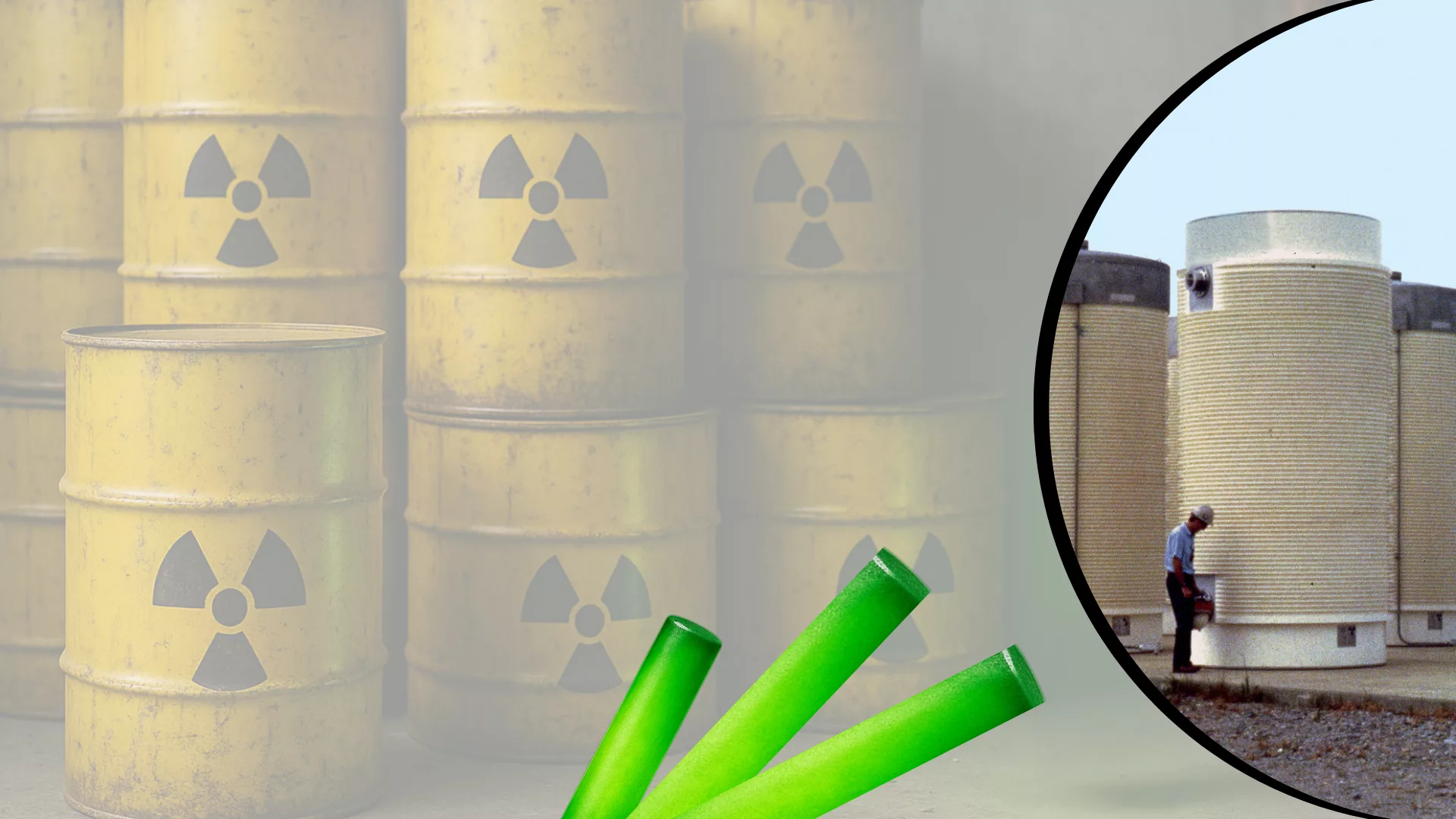
Yellow Barrels and Glowing Rods? What Our Radioactive Waste Really Looks Like
There are various types of radioactive waste. However, popular culture almost always misleads us about their properties…
.jpg)