30 years of research – for the sake of hundreds of thousands of years of safety
Research on the Opalinus Clay has been carried out at the Mont Terri Rock Laboratory since 1996. The clay rock is the key to the post-closure safety of Switzerland’s deep geological repository.
.png)
Radioactive waste emits radiation for farlonger than humans can plan into the future. This is why Switzerland will notonly rely on engineered barriers as part of the repository system but above allon geological barriers. The Opalinus Clay is the most important barrier of all.
The clay rock can contain the radioactive wastelong enough to allow it to decay to a harmless level. For 30 years now, theMont Terri Rock Laboratory in Canton Jura has been investigating how well theOpalinus Clay can contain radionuclides.
Threefavourable properties
Around 175 million years ago, a shallow seaonce covered what is now Northern Switzerland. At the bottom of the sea, minutesedimentary particles were deposited layer by layer. As these layers increased,their weight compressed the underlying layers, which slowly solidified intorock – the Opalinus Clay. The rock layer eventually reached a thickness of agood 100 metres and will one day host the deep geological repository.
The Opalinus Clay is the key element ofSwitzerland’s repository. This is due to three special properties. Firstly, therock has very fine pores, which allow it to retain substances – includingradioactive ones – in the long term. Secondly, it can self-seal fissures.Thirdly, many radioactive particles, so-called radionuclides, adhere to the clayminerals.
“Thanks to the Mont Terri Rock Laboratory, theOpalinus Clay is considered to be the best researched clay rock in the world.The demonstration of post-closure safety is not based exclusively on Nagra’sfindings, but is also supported by the research results of an internationalscientific community,” says Olivier Leupin. The experienced geochemist hasconducted experiments in the underground research laboratory for decades.
A rock thatcan self-seal fissures
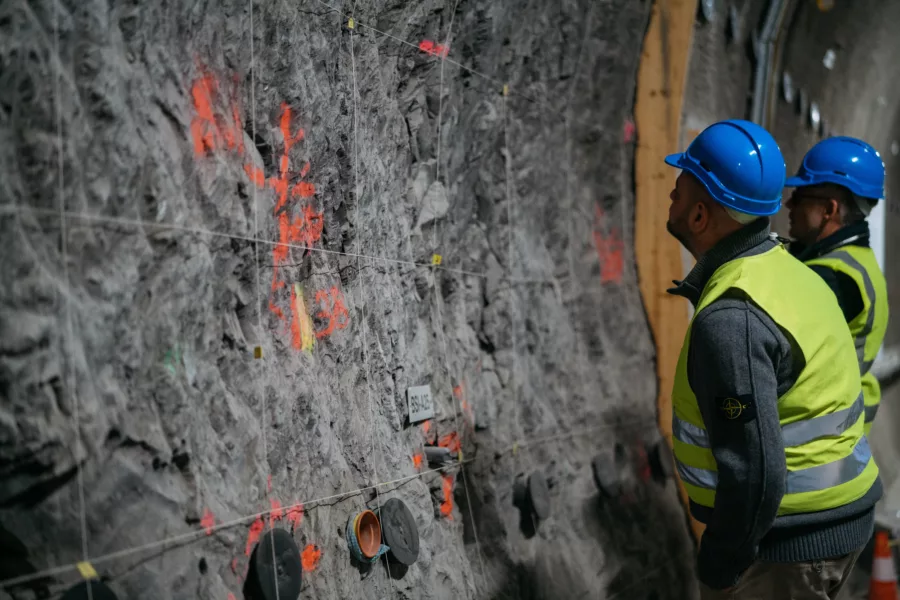
What would happen if the Opalinus Clay were tofracture due to underground stresses? What if fissures were to form? Thesequestions have also been investigated at Mont Terri, and the answer is: whenwater penetrates the Opalinus Clay, the rock swells – self-sealing anypotential fissures.
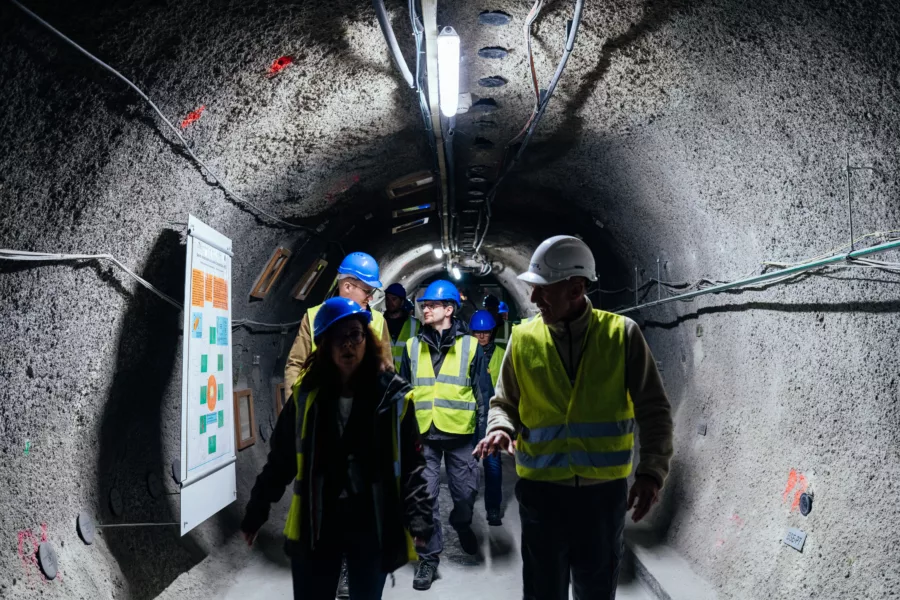
The Mont Terri Rock Laboratory will not beconverted into a deep geological repository; since 1996, it has beenexclusively used as an underground research laboratory. The laboratory, inwhich several countries are conducting investigations, is located around 300metres below the earth’s surface next to the safety gallery of a motorwaytunnel. Here, researchers can directly observe how the Opalinus Clay behavesunder the influence of water, heat and pressure, and how it reacts withmaterials such as steel or concrete.
1:1-scalemodel
The so-called Full-scale Emplacement experimentis particularly illustrative. In this long-term experiment, researchers aretesting on a 1:1 scale how the disposal canisters for high-level waste, theOpalinus Clay and the bentonite backfill material interact. The disposalcanisters used in the experiment do not contain any radioactive materials, butare heated to simulate the heat emitted by spent fuel assemblies. Hundreds ofmeasurement devices supply continuous data.
The relatively soft Opalinus Clay ischaracterised by properties that are very favourable for post-closure safety,but, when it comes to constructing the repository, tunnelling engineers concedethat it will be challenging. When a drift is excavated deep below ground, therock tries to close the void again because of the high pressure being exertedon it from above. Construction methods are therefore being tested at Mont Territo find a method that will allow the rock to be handled as carefully and safelyas possible.
Nobody can conduct an experiment over hundredsof thousands of years. Nevertheless, Nagra must demonstrate that a repositorywill remain safe even in the very distant future. This requires many puzzlepieces to be assembled: laboratory measurements, experiments in undergroundresearch laboratories, drilling deep boreholes in the siting region, modellingand safety analyses.
Fromscientific research to construction technology
Over the past three decades, the Mont TerriRock Laboratory has provided important insights into the properties of theOpalinus Clay. Can this rock help to contain radioactive waste until it nolonger poses a hazard to humans and the environment?
Thanks in part to the researchat Mont Terri, this question can now be answered in the affirmative.Investigations inside the mountain continue. The focus is increasingly on howto safely construct and operate the deep geological repository in the OpalinusClay.
You may also be interested in
We believe in transparency. Here you can find the latest updates and information about this landmark project.
Yellow Barrels and Glowing Rods? What Our Radioactive Waste Really Looks Like
There are various types of radioactive waste. However, popular culture almost always misleads us about their properties…
.jpg)